
STATE-OF-THE-ART OF SHAPE MEMORY ACTUATORS Dr. A. D. Johnson
Dr. Johann Krämer
Daimler-Benz AG, Stuttgart, Germany
Shape-memory actuators are used where a large force and stroke are required and thermodynamic efficiency is not essential. Since the discovery of shape memory in titanium-nickel, a number of inventions have been made having applications in medicine, aerospace, automotive, and consumer products. These devices range in size from meters to micrometers. Sales are now more than a hundred million USD per year.
This paper reviews some examples of past and present state-of-the-art applications. Some have been successful in the marketplace, others not, suggesting directions for future development.
Introduction
The first SMAs appeared about 50 years ago, and gained momentum with the discovery at the Naval Ordnance Laboratory in the 1960s of titanium-nickel SMAs. These were named NITINOL, and the name still applies to these materials.[1][2] The more common abbreviation is TiNi. Many other SMAs have been developed.[3] This discussion is limited to titanium-nickel based systems.
Actuators do not constitute the largest amounts of TiNi in use. These are superelastic devices, in antennas for cellular telephones, in eyeglass frames and in medical devices, especially catheter guide wires, dental arches, and stents.
Herewith is a brief review of selected examples of shape-memory actuators. This is not a recitation of all the devices made but an attempt to recall some historical machines, look at some of the current uses, and suggest where this industry might go in the not-too-distant future.
The reason for use of shape-memory alloys as actuators is that a large amount of work can be obtained in a small volume. Repeated cycling at 3 percent strain and more than 200 mPa stress produces more than a joule of work output per cycle, among the highest work densities known.[4]
Fig. 1: Early shape-memory alloy engine.
The helical TiNi spring is under tension so it is stretched. In the hot bath, it contracts due to the shape-memory. This causes a clockwise torque on Pulley A that is larger than the counterclockwise torque on Pulley B, and they rotate in the direction shown by the arrows. This carries TiNi into the cold bath where it transforms to the martensite and relaxes. The result is a rapid, continuous rotation of the pulleys A,B.
Heat Engines
The first utilization to gain notoriety, in the 1970s, was in heat engines. TiNi made it easy to convert heat to mechanical energy at water temperatures, and several inventors produced working heat engines. Figure 1 shows one of these inventions. These engines had low efficiency, but high power density.
The existence of small working heat engines suggested that the energy shortage might be eased by substituting low delta-T sources for petrochemicals. Practicality required engines delivering hundreds of kilowatts, and this proved to be much more difficult than was anticipated. Scale-up stopped at about one kilowatt: it failed for engineering and economic reasons. Large masses of metal must be rapidly cycled to achieve high power, requiring accurate control of flows, temperatures, large forces, and friction. Compared with inexpensive oil, even waste heat becomes expensive when investment, maintenance, and transportation are considered. Many ingenious models were constructed at McDonnell-Douglas, Lawrence Berkeley Laboratory, Sharp, and others, including individuals.[5]
Other early applications
An example of promising actuators was a self-opening vent for regulating temperatures in habitations and greenhouses. This proved impractical because of the high cost of SMA material, and the variation in force required to open a mechanism exposed to weather for extended time.
One successful application was a connector for hydraulic lines, consisting of a tube which is pre-strained to contract and tightly grip two ends of pipe.[6] This application continues to grow because of its superiority.
Current applications of shape memory actuators
Use in space was an early predicted application, and continues to grow. One form of separation device, the Frangibolt, has been used on numerous space missions[7].

Fig. 2: ‘Frangibolt’ separation system.
The Frangibolt consists of an electric heater surrounding a hollow cylinder of TiNi and a specially-notched bolt. The TiNi actuator is prepared by compressing it 5 percent of its length, then securing it through the TiNi cylinder with a nut: a payload is secured for launch. To deploy the payload, electric power heats the TiNi actuator cylinder, it expands and elongates the notched bolt to fracture. A 1.5 cm diameter actuator delivers a force of 3 x 10⁵ newtons.
In the early days of TiNi SMA good material such as fine-gage wire was not available, and this impeded work for many researchers. At the present time there is available not only excellent material but how-to instructions enabling the unfamiliar user to build successful prototypes. [8] Many users have become acquainted with SMA and have produced successful products.
There are several toys and novelties. A Monarch butterfly, shown in Figure 3, moves its wings gracefully in response to pulses of electricity.

Fig. 3: TiNi actuated butterfly.
Several designs exist for steerable catheters used in medicine. [9]
A variety of anti-scald valves are marketed. These sense the temperature of water being delivered to a shower, and close if it reaches a dangerous level.[10]
In Daimler-Benz automotive transmissions, a TiNi valve has been used to compensate for viscosity change with temperature.[11]
A short length of TiNi wire, 100 microns in diameter, is used in computer magnetic drives to unlatch the floppy disk.[12]
Braille and tactile devices have been developed.
Microdevices
The resistivity of TiNi is approximately 80 microhm cm, and is suitable for Joule heating which provides a simple means of actuation. However, for macroscopic devices this is generally impractical for two reasons. Thermodynamic efficiency is low because of the small temperature difference in which the transition takes place, and removal of heat is slow. SMA wire has not replaced electric motors for many applications.
In making devices smaller than a millimeter in size the situation is different. Thermodynamic efficiency may be irrelevant in specific cases, and removal of heat is rapid, especially in thin films where the surface area is large compared to the volume. Cycle rates above a kiloherz are feasible, in air.
TiNi has been shown to retain shape-memory and superelastic characteristics down to very small dimensions. [13] Metal is ‘refined’ in sputtering, so that the resulting material has finer grain structure and greater strength than parent material.
Micro-Electro-Mechanical Systems (MEMS) provides a means of inexpensive mass manufacture of these devices. Components such as valves, sensors, and channels can be integrated by fabrication on the same substrate, offering an opportunity to make miniature analytical instruments such as portable gas chromatographs that can change the way people work.
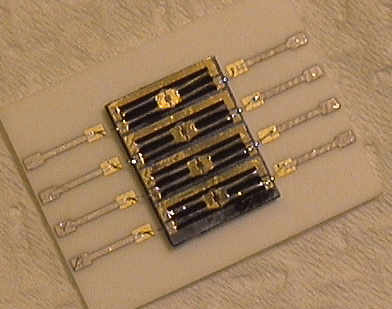
Fig 4: Array of shape-memory valve actuators.
Four TiNi actuators are formed on a silicon substrate 1 cm by 1.4 cm and wire-bonded to a ceramic substrate. These valves operate on 0.25 watts of power with flow rates of 1 liter per minute at 1 atm. They can be operated in proportional mode or opened and closed in 20 msec.
These facts have opened a new activity in shape memory alloys. Valves, switches, mirrors, micropositioners, micro-robotic systems are being readied for use in a variety of industries. Drug discovery, PCR, and DNA synthesis require analysis of sub-nanoliter samples: these systems are required to have minimal internal volume which demands that valves and pumps must be small and placed close together. Figure 4 illustrates a multiple-valve array intended for this purpose.
Fatigue has always been a concern for developers of SMA applications. In macroscopic devices it is difficult to register large numbers of cycles because the cycle rate is low. Higher cycle rates in miniature devices remove this limitation, and lifetimes of many millions of cycles have been demonstrated.
The next generation of TiNi microdevices will be much smaller. Micromachined switches can replace electronic components and reduce insertion losses, resulting in overall power reduction. Arrays of bistable microrelays could provide a non-volatile memory for networks. Figure 5 shows a latch mechanism that is actuated by a TiNi microribbon .
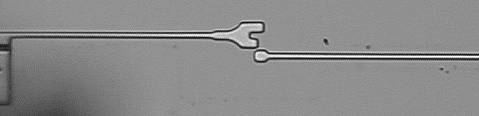
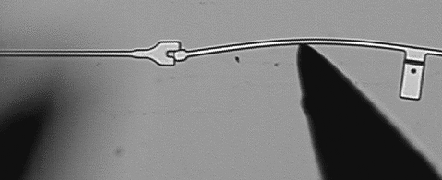
Fig. 5: Microactuated latch mechanism (after Comtois)
The photographs show two mating cantilevers of polysilicon that are micromachined to latch at one end while anchored to the substrate at the other. A microactuator (not shown) pulls one cantilever until it catches the other, and remains latched when the force is removed. The pair of cantilevers can be unlatched by a second microactuator displacing the other cantilever.
Oscillating mirrors used in scanners can be driven by SMA microactuators with a considerable reduction in size and weight. Micropositioners are needed for fiber optic switching systems.
It is unlikely that SMA-driven microrobots will perform as stand-alone devices because of the power requirement. However, hybrid systems combining micro-robots with macro servo systems, in analogy with the shoulder-arm-hand-finger mechanism, may be very useful. A low-mass actuator is needed to go at the end of positioning systems such as read-write heads in computer disk drives.
Impediments to further development
What are the obstacles to development at this time? The cost of TiNi remains high. Purity of materials for sputtering, for example, is difficult to verify. The database of engineering knowledge and materials characterization needs improvement to avoid costly and discouraging repetition.
Several potential markets are inaccessable to binary TiNi shape memory alloys, since their martensite-to-austenite transition is completed below 100 ° C. It is important that the useful range be extended to 200 ° C and beyond. Researchers have created alloys of TiNiPd and TiNiHf.[14] Why have such alloys not become available? One reason is that the proposed materials are difficult to make and are brittle, so they are costly to form into products.
Summary
Shape-memory alloy is still an inventor’s material. Only a few entrepreneurs have made fortunes in SMA.
No ‘killer-application’, that is a fad-type item, has found its way into the consumer market.
Many early suggested applications failed to achieve large markets, generally because they did not compete successfully in mature markets due to addressing a problem that already has a solution, or solving the wrong problem.
Despite a slow start, SMAs have grown from curiosities to a sizable industry, and will keep on growing.
Actuators have not kept pace with superelastic applications. Medical applicationms in particular have embraced the use of shape-memory wires, but miniaturized implantable systems have not matured as yet.
Cost of manufacture drives all the applications, with the possible exception of ue in space.
Microactuation represents a significant departure from conventional actuators. Microvalves and microrelays are foreseen as offering growth opportunities for emerging micromachining industries.
Miniaturization will continue. The driving forces are cost, portability, and the need to achieve small internal volume. Component integration will lead to pocket-size anaylitical instruments and consumer products.
References
[1] C.M. Jackson, H.J. Wagner, R.J Wasilewski, 55-Nitinol- the alloy with a memory, its physical metallurgy properties, and applications, NASA-SP 5110. Available in U.S. from National Technical Information Service.
[2] W.J. Buehler, R.C. Wiley, F.E. Wang, Nickel-Based Alloys, U.S. Patent Number 3,174,851, 23 March 1965.
[3] Hiroyasu Funakubo, Ed., Shape Memory Alloys, Gordon and Breach Publishers, 1984.
[4] P. Krulevitch, A.P.Lee, P.B. Ramsey, J.C. Trevino, J. Hamilton, M.A. Northrup, Thin Film Shape Memory Alloy Microactuators, J.MEMS, vol. 5, No. 4, December 1996.
[5] W.S. Ginell, J.L. McNichols, J.S. Cory, Nitinol heat engines for low-grade thermal energy conversion, Mechanical Engineering Magazine, May 1979.
[6] L.M. Schetky, Shape-Memory Alloys, Scientific American, November 1979, pages 74-82.
[7] A.D. Johnson, Non-explosive separation device, U.S. Patent Number 5,119,555, June 1992.
[8] Roger Gilbertson, Mondotronics Inc., San Rafael CA USA. Tel. 425-491-4600.
[9] P. Dario, M.C. Montesi, Shape memory alloy microactuators for minimally invasive surgery, Proceedings of SMST-94 conference, Asilomar CA, March 1994.
[10] M.H. Wu, W.A. Ewing, Pilot-operated anti-scald safety valve: design and actuator considerations, SMST-94 proceedings, Asilomar CA, March 1994.
[11] Dieter Stoeckel, NDC, personal communication.
[12] Wayne Brown, Dynalloy Inc, Irvine CA, personal communication.
[13] A.D. Johnson, Vacuum-deposited TiNi shape memory film: characterization and applications in microdevices, J-MEMS, December 1991.
[14] D.N. Abujudom, P.E. Thoma, K. Ming-Yuan, D.R. Angst, High transformation temperature shape memory alloy, U.S. Patent No. 5,114,504, May 1992.